RCDs
A residual current device (RCD) trips as soon as current leaks away, for example through a person. The AREI, the Belgian electrical installation regulations, sets out which sensitivity goes where: one main RCD at the start, and 30 mA for the circuits the AREI lists, such as the socket outlets, the lighting and the bathroom.
Why do RCDs exist?
A circuit breaker reacts to too much current in the cable. But someone who touches a faulty appliance lets far too little current flow through their body to make a circuit breaker trip. That is what the residual current device (RCD) is for.
It compares the current going into a circuit with the current coming back. If they are not equal, current is flowing along another path, for example through a person or to a metal casing, and the RCD trips.
The value in mA is the rated tripping current (IΔn): the lower it is, the more sensitive the RCD. The AREI works with two levels:
- 300 mA at most for the main RCD at the start of the installation;
- 30 mA at most for the circuits the AREI lists (see below).
How to place them in a dwelling
Work in this order:
- At the start of the installation, place a main RCD of 300 mA at most and, in a dwelling, at least 40 A. Several side by side are allowed.
- Immediately after it, place at least one RCD of 30 mA at most for the socket outlets (not those of fixed appliances), the lighting, the rooms with a bath or shower, and the washing machines, tumble dryers and dishwashers.
- Count the final circuits behind each 30 mA RCD: there are 8 at most.
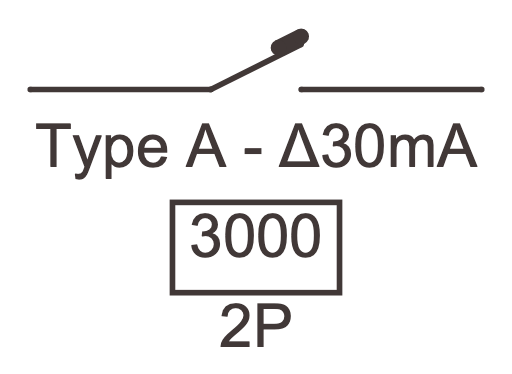
- Choose at least type A for every RCD.
A socket outlet that only feeds a permanently installed appliance, such as an oven, the cooker or the steam oven, does not have to be behind 30 mA. Whether the appliance is really permanently installed cannot be seen from the diagram: that is checked on site.
Why eight circuits and type A?
When a leakage current occurs, the whole RCD trips. The more circuits behind it, the larger the part of the dwelling that loses power at the same time because of a single fault. That is why the number is limited to 8 final circuits per 30 mA RCD. If you have more, use a second RCD.
The type tells you which kind of leakage current the RCD is built for. In a dwelling, type AC is not allowed: choose at least type A and read the type on the device itself.
During the inspection, the inspector checks, among other things, whether:
- the main RCD is 300 mA at most and at least 40 A;
- the test button of every RCD works and is accessible;
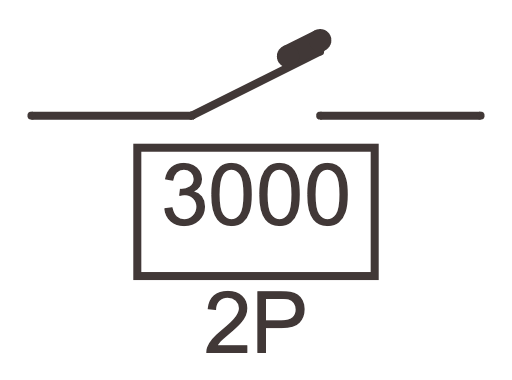
- the single-line diagram states the type and characteristics of every RCD, including the tripping current in mA.
Example: A dwelling with three bedrooms
You are planning the final circuits of a new dwelling with 3 bedrooms. How many circuits go behind a 30 mA RCD?
| Final circuit | Number | Behind 30 mA |
|---|---|---|
| Lighting (more than two rooms: at least two circuits) | 2 | Yes |
| Socket outlets (8 at most per circuit, here spread over three circuits) | 3 | Yes |
| Washing machine, tumble dryer and dishwasher (each on its own circuit) | 3 | Yes |
| Cooker and electric oven (each on its own circuit) | 2 | Not required for a permanently installed appliance |
Behind the first 30 mA RCD there are 2 + 3 + 3 = 8 circuits: that is the limit. If you also put the cooker and the oven behind it, there are 10. In that case, use a second 30 mA RCD.
At the start of the installation there is a main RCD of 300 mA at most and, in a dwelling, at least 40 A. Every RCD is at least type A.
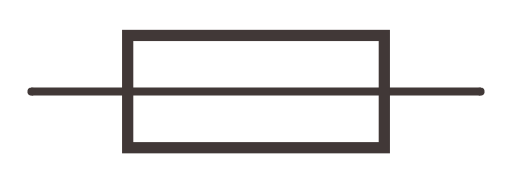
The protective devices in the distribution board
Pitfall: Type AC and the ninth circuit
- Type AC. In a dwelling, a type AC RCD is not allowed. Choose at least type A and read the type on the device itself.
- Nine circuits behind one RCD. Behind a 30 mA RCD there are 8 final circuits at most. Count them before you add a circuit.
- The test button. During the inspection, the test button of every RCD must work and be accessible.
Tip: Always count three things
- Main RCD: 300 mA at most, 40 A at least.
- Final circuits behind 30 mA: 8 at most per RCD.
- Type: at least type A on every RCD.
What the AREI says
Art. 4.2.4.3 b
At the start of the installation there is at least one RCD (several side by side are allowed) of 300 mA at most.
Art. 4.2.4.3 b, 5.3.5.3 a
Each RCD at the start is 300 mA at most and, in a dwelling, at least 40 A.
Art. 4.2.4.3 b
Immediately after the main RCD: at least one RCD of 30 mA at most for the socket outlets (not those of fixed appliances), the lighting, the rooms with a bath or shower, and the washing machines, tumble dryers and dishwashers.
Art. 4.2.4.3 b
No more than eight final circuits behind a 30 mA RCD.
Art. 5.3.5.3 a
In a dwelling: RCDs on alternating current are at least type A (type AC is not permitted).
Source: AREI Book 1, version 07. Translation by Bluebits; only the official text of the AREI is authoritative.
In short
- An RCD trips when there is a leakage current, for example through a person; a circuit breaker does not.
- The main RCD is 300 mA at most and, in a dwelling, at least 40 A.
- Socket outlets, lighting, bath or shower, and washing machines, tumble dryers and dishwashers go behind 30 mA at most.
- Behind one 30 mA RCD there are 8 final circuits at most.
- In a dwelling you need at least type A: type AC is not allowed.
- The test button works and is accessible.
There are no comments for now.
to be the first to leave a comment.